



Published Date: Wednesday, 24 December 2025, 14:36
A faculty member at the University of Zakho, from the College of Science, Department of Computer Science, has succeeded in conducting an astronomical research study, the results of which meet high academic standards and have been published in an international scientific journal.
It is worth noting that the study addresses the relationship between modified gravity (dark matter) and a new formulation of Newtonian dynamics in explaining galaxy rotation, demonstrating that galaxy rotation can be explained more effectively than by conventional dark matter theories.
A new scientific study published in the journal "Astrophysics and Space Science" has revealed that a very simple physical model can explain the rotational behavior of disk galaxies with higher accuracy than dark matter models and alternative, non-Newtonian gravity theories.
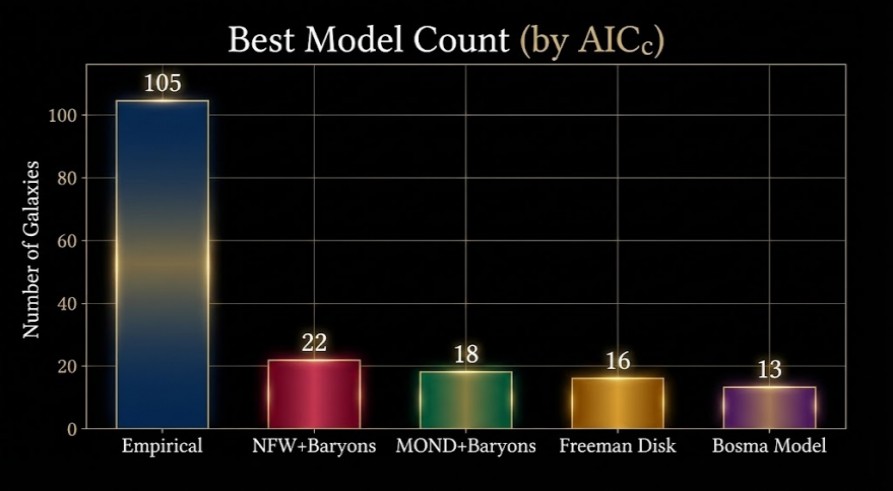
The researchers relied on high-precision data from 175 galaxies drawn from the SPARC database and compared five different models using advanced statistical methods. The results showed that an empirical law based on a single factor, directly linked to the observed rotational acceleration of each galaxy, performed best in more than 60% of the studied galaxies and achieved the highest quality of fit with the observational data.
By contrast, the widely used dark matter model (NFW) was successful only in explaining a limited number of cases, while other models such as MOND, the Freeman disk, and the Bosma model produced weaker results.
The study emphasizes that this simple law, which is constructed directly from observational measurements, may represent a fundamental principle governing the dynamics of disk galaxies. This, in turn, opens the door to rethinking the complex models currently employed to understand the structure of galaxies and their rotational behavior.

College of Science
Duhok, Kurdistan Region
Zakho International Road, Iraq